Today's
EarthStation1.com 15% Off Commemorative Memorial Title: Civil Jets
The Boeing 707 C135 Stratolifter KC135 Tanker DVD, MP4, USB
Today, November 24, 2025
November 24: D. B. Cooper Day: --
November 24, 1971: During a severe thunderstorm over Washington
state, a hijacker calling himself Dan Cooper (aka D. B. Cooper)
parachutes from Northwest Orient Airlines Flight 305, a Boeing 727
aircraft bound from Portland, Oregon, to Seattle, Washington with
200K USD ransom money. He has never been found. Cooper told the
flight crew he had a bomb, and demanded both the ransom and four
parachutes upon landing in Seattle. After releasing the passengers
in Seattle, Cooper directed the crew to refuel the aircraft and
begin a second flight to Mexico City, with a refueling stop in
Reno, Nevada. After taking off from Seattle, Cooper opened the
aircraft's aft door, deployed the airstair, and parachuted to an
uncertain fate over a remote, heavily wooded area of southwestern
Washington. Because of a reporter's error, the hijacker became
known as D. B. Cooper. The hijacker's true identity and fate
remain unknown. In 1980, a small portion of the ransom (5.8K USD)
was found along the riverbanks of the Columbia River near
Vancouver, Washington. Its discovery renewed public interest in
the crime, but yielded no additional information, and the
remaining money was never recovered. For forty-five years after
the hijacking, the Federal Bureau of Investigation (FBI)
maintained an active investigation and built an extensive case
file, but did not reach any definitive conclusions about Cooper's
identity. Agents investigating the case had mixed opinions about
whether he survived his jump. In 2016, the FBI officially
suspended active investigation of the case, although reporters,
enthusiasts, professional investigators, and amateur sleuths
continue to pursue numerous theories for Cooper's identity and
fate. The crime is the only documented unsolved case of air piracy
in the history of commercial aviation. Cooper's hijacking-and
several imitators in the year after-prompted immediate and major
upgrades to security measures for airports and commercial
aviation. Metal detectors were installed at airports, baggage
inspection became mandatory, and passengers who paid cash for
tickets on the day of departure were selected for additional
scrutiny. Boeing 727s were retrofitted with eponymous "Cooper
vanes", designed to prevent the aft staircase from being
lowered in-flight. By 1973, aircraft hijacking incidents had
decreased, as the new security measures dissuaded would-be
hijackers whose only motive was money. On Sale @ 15% Off Discount
Till Midnight PT!
https://store.earthstation1.com/civil-jets-the-boeing-707-c135-stratolifter-kc135-t707135135.html
Today's
EarthStation1.com 15% Off Commemorative Memorial Title: The
American Adventure: TV History Series 1607-1876 DVD MP4 USB Drive
Today, November 24, 2025
November 24, 1832: The United States: The
History Of The United States: The Constitution Of The United
States: Nullification (U.S. Constitution): The Nullification
Crisis: The Ordinance Of Nullification: -- South Carolina passes
The Ordinance Of Nullification, declaring that the Tariffs of 1828
and 1832 were null and void in the state, beginning the
Nullification Crisis. Passed by a state convention on November 24,
1832, it led to President Andrew Jackson's Nullification
Proclamation of December 10, 1832, a proclamation against South
Carolina which threatened to send government troops into the state
to enforce the tariffs. In the face of the military threat, and
following a Congressional revision of the law which lowered the
tariff, South Carolina repealed the ordinance. The protest that
led to The Ordinance Of Nullification was caused by the belief
that the tariffs of 1828 and 1832 favored the North over the
South, and therefore violated the Constitution. This led to an
emphasis on the differences between the two regions, and helped
set the stage for conflict during the antebellum era which
eventually led to The American Civil War. On Sale @ 15% Off
Discount Till Midnight PT!
https://store.earthstation1.com/the-american-adventure-series-us-1st-century-4-dv14.html
Today's
EarthStation1.com 15% Off Commemorative Memorial Title: The Old
Time Radio Western MegaSet MP3 Collection DVD, Download, USB
Today, November 24, 2025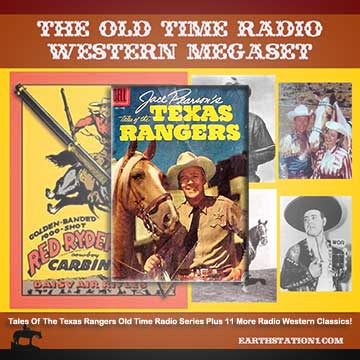
November 24, 1835: Law Enforcement: Law
Enforcement In The United States: The Texas Ranger Division (The
Texas Rangers, The Diablos Tejanos (Spanish: "Texan Devils"):
-- The Texas Provincial Government authorizes the creation of a
horse-mounted police force called The Texas Rangers, which is now
The Texas Ranger Division of The Texas Department Of Public
Safety. At that time, what is today the State Of Texas was part of
The Province Of Coahuila Y Tejas, belonging to the newly
independent country of Mexico. The unique characteristics that the
Rangers adopted during the force's formative years and that give
the division its heritage today -- characteristics for which the
Texas Rangers would become world-renowned -- have been accounted
for by the nature of the Rangers' duties, which was to protect a
thinly populated frontier against protracted hostilities, first
with Plains Natives tribes, and after the Texas Revolution,
hostilities with Mexico. By the early 1830s, the Mexican War of
Independence had subsided, and some 60 to 70 families had settled
in Texas-most of them from the United States. Because there was no
regular army to protect the citizens against attacks by native
tribes and bandits, in 1823, Stephen F. Austin organized small,
informal armed groups whose duties required them to range over the
countryside, and who thus came to be known as "rangers".
Around August 4, 1823, Austin wrote that he would " ...
employ ten men ... to act as rangers for the common defense ...
the wages I will give said ten men is fifteen dollars a month
payable in property ... " John Jackson Tumlinson Sr., the
first alcalde of the Colorado district, is considered by many
historians of the Texas Rangers to be the first killed in the line
of duty. While there is some discussion as to when Austin actually
employed men as "rangers", Texas Ranger lore dates the
anniversary year of their organization to this event. However, the
Texas Rangers were not formally constituted until 1835. Austin
returned to Texas after having been imprisoned in Mexico City and
helped organize a council to govern the group. On October 17, at a
consultation of the Provisional Government of Texas, Daniel Parker
proposed a resolution to establish the Texas Rangers. He proposed
creating three companies that would total some 60 men and would be
known by "uniforms" consisting of a light duster and an
identification badge made from a Mexican peso. They were
instituted by Texan lawmakers on November 24. On November 28,
1835, Robert McAlpin Williamson was chosen to be the first Major
of the Texas Rangers. Within two years the Rangers grew to more
than 300 men. In their early days, Rangers performed tasks of
protecting the Texas frontier against Native Americans' attacks on
the settlers. During the Texas Revolution, they served mainly as
scouts, spies, couriers, and guides for the settlers fleeing
before the Mexican Army and performed rear guard during the
Runaway Scrape and general support duties. On Sale @ 15% Off
Discount Till Midnight PT!
https://store.earthstation1.com/the-old-time-radio-western-megaset-dual-layer-mp3-dv3.html
Today's
EarthStation1.com 15% Off Commemorative Memorial Title: Charles
Darwin: The Devil's Chaplain + Bonus Title Video Download DVD
Today, November 24, 2025
November 24, 1859: Evolution: The Theory
Of Evolution: First Publications -- Charles Darwin's book "On
the Origin Of Species By Means of Natural Selection" is first
published, theorizing that all the living creatures descended from
a common ancestor. It is considered to be the foundation of
evolutionary biology, commonly known as evolution. Darwin's book
introduced the scientific theory that populations evolve over the
course of generations through a process of natural selection. It
presented a body of evidence that the diversity of life arose by
common descent through a branching pattern of evolution. Darwin
included evidence that he had gathered on the Beagle expedition in
the 1830s and his subsequent findings from research,
correspondence, and experimentation. On Sale @ 15% Off Discount
Till Midnight PT!
https://store.earthstation1.com/charles-darwin-the-devil39s-chaplain-theory-of-evolution-sa39.html
Today's
EarthStation1.com 15% Off Commemorative Memorial Title: The Civil
War: A Video Image History JPG Set + MPG DVD, Download, USB
Today, November 24, 2025
November 24, 1863 : November 11, 1864:
The American Civil War (The Civil War, The War Between The
States): The Eastern Theater Of The American Civil War: The
Chattanooga Campaign: The Battles Of Chattanooga: The Battle Of
Chattanooga (The Third Battle Of Chattanooga): The Battle Of
Lookout Mountain (The Battle Above The Clouds): -- Union forces
under Maj. Gen. Joseph Hooker assault Lookout Mountain in
Chattanooga, Tennessee, and defeat Confederate forces commanded by
Maj. Gen. Carter L. Stevenson. Lookout Mountain was one engagement
in the Chattanooga battles between Maj. Gen. Ulysses S. Grant's
Military Division of the Mississippi and the Confederate Army of
Tennessee, commanded by Gen. Braxton Bragg. It drove in the
Confederate left flank and allowed Hooker's men to assist in the
Battle Of Missionary Ridge the following day, which routed Bragg's
army, lifting the siege of Union forces in Chattanooga, and
opening the gateway into the Deep South. On Sale @ 15% Off
Discount Till Midnight PT!
https://store.earthstation1.com/the-civil-war-a-video-image-history-photo-cd-mpg-video-cdrom.html
Today's
EarthStation1.com 15% Off Commemorative Memorial Title: Art
Documentaries And Films DVD MP4 Video Download USB Flash Drive
Today, November 24, 2025
November 24, 1864: #BOTD: #HBD! Henri de
Toulouse-Lautrec, French painter, printmaker, draughtsman,
caricaturist and illustrator (d. September 9, 1901) is #born Henri
Marie Raymond de Toulouse-Lautrec-Monfa at the Hotel du Bosc in
Albi, Tarn, in the Midi-Pyrenees region of France. Comte Henri
Marie Raymond de Toulouse-Lautrec-Monfa's immersion in the
colourful and theatrical life of Paris in the late 19th century
allowed him to produce a collection of enticing, elegant, and
provocative images of the sometimes decadent affairs of those
times. Born into the aristocracy, Toulouse-Lautrec broke both his
legs around the time of his adolescence and, due to the rare
condition Pycnodysostosis, was very short as an adult due to his
undersized legs. In addition to his alcoholism, he developed an
affinity for brothels and prostitutes that directed the subject
matter for many of his works recording many details of the
late-19th-century bohemian lifestyle in Paris. Toulouse-Lautrec is
among the painters described as being Post-Impressionists, with
Paul Cezanne, Vincent Van Gogh, Paul Gauguin, and Georges Seurat
also commonly considered as belonging in this loose group. In a
2005 auction at Christie's auction house, La Blanchisseuse, his
early painting of a young laundress, sold for 22.4M USD, setting a
new record for the artist for a price at auction. Henri de
Toulouse-Lautrec died at the age of 36 from complications due to
alcoholism and syphilis at his mother's estate, Chateau Malrome,
in Saint-Andre-du-Bois, a commune in the Gironde department in
Nouvelle-Aquitaine in southwestern France. He is buried in
Cimetiere de Verdelais, Gironde, a few kilometres from the estate.
On Sale @ 15% Off Discount Till Midnight PT!
https://store.earthstation1.com/art-documentaries-and-films-dvd-mp4-video-download-usb-flash-driv4.html
Today's
EarthStation1.com 15% Off Commemorative Memorial Title: The
History Of Jazz A Video Retrospective DVD, MP4 Download, USB Drive
Today, November 24, 2025
November 24, 1868: #BOTD: #HBD! Scott
Joplin, African American composer and pianist dubbed the "The
King Of Ragtime" who achieved fame for his ragtime
compositions such as "The Entertainer" (d. April 1,
1917) is #born in Texarkana, Texas. During his brief career, he
wrote 44 original ragtime pieces, one ragtime ballet, and two
operas. One of his first, and most popular pieces, the "Maple
Leaf Rag", became ragtime music's first and most influential
hit, and has been recognized as the archetypal rag. Joplin was
#born into a musical family of railway laborers in Northeast
Texas, and developed his musical knowledge with the help of local
teachers. Joplin grew up in Texarkana, where he formed a vocal
quartet, and taught mandolin and guitar. During the late 1880s he
left his job as a laborer with the railroad, and travelled around
the American South as an itinerant musician. He went to Chicago
for the World' Fair of 1893, which played a major part in making
ragtime a national craze by 1897. Scott Joplin died of syphilitic
dementia at the age of 48 at Manhattan State Hospital, a mental
institution in Manhattan, New York City. He was buried in a
pauper's grave that remained unmarked for 57 years at St.
Michael's Cemetery in East Elmhurst, Queens. His grave was finally
given a marker in 1974, the year The Sting, which showcased his
music, won for Best Picture at the Oscars. On Sale @ 15% Off
Discount Till Midnight PT!
https://store.earthstation1.com/the-history-of-jazz-by-billy-taylor-parts-i-amp-ii-dvd.html
Today's
EarthStation1.com 15% Off Commemorative Memorial Title: The Cattle
Barons Of The Wild West MP4 Video Download DVD
Today, November 24, 2025
November 24, 1874: Great Inventions: --
Joseph Glidden patented his invention of barbed wire. It helped
tame the wild American West, and has been the bane of infantry and
land forces ever since. To demonstrate the effectiveness of barbed
wire, Glidden and his sales agent for the State of Texas, Marques
Fortner, in 1881 developed the "Frying Pan Ranch" in
Bushland in Potter County near Amarillo, Texas. The wire was
brought in by wagon from the railhead at Dodge City, Kansas, and
the timbers were cut from Palo Duro Canyon and along the Canadian
River Valley. A herd of 12,000 head of cattle was branded with the
"Panhandle Brand", which the cowboys called "frying
pan". The ranch proved the success of the wire and changed
ranching. Life in the American West was reshaped by a series of
patents for this simple tool that helped ranchers tame the land.
Nine patents for improvements to wire fencing were granted by the
U.S. Patent Office to American inventors, beginning with Michael
Kelly in November 1868 and ending with Joseph Glidden in November
1874. Barbed wire not only simplified the work of the rancher and
farmer, but it significantly affected political, social, and
economic practices throughout the region. The swift emergence of
this highly effective tool as the favored fencing method
influenced life in the region as dramatically as the rifle,
six-shooter, telegraph, windmill, and locomotive. Barbed wire was
extensively adopted because it proved ideal for western
conditions. Vast and undefined prairies and plains yielded to
range management, farming, and ultimately, widespread settlement.
As the use of barbed wire increased, wide open spaces became less
wide, less open, and less spacious, and the days of the free
roaming cowboy were numbered. Today, cowboy ballads remain as
nostalgic reminders of life before barbed wire became an accepted
symbol of control, transforming space to place and giving new
meaning to private property. Before the invention of barbed wire,
the lack of effective fencing limited the range of farming and
ranching practices, and with it, the number of people who could
settle in an area. Wooden fences were costly and difficult to
acquire on the prairie and plains, where few trees grew. Lumber
was in such short supply in the region that farmers were forced to
build houses of sod. Likewise, rocks for stone walls-commonly
found in New England-were scarce on the plains. Shrubs and hedges,
early substitutes for wood and rock fencing materials, took too
long to grow to become of much use in the rapidly expanding West.
Barbed wire was cheaper, easier, and quicker to use than any of
these other alternatives. Without fencing, livestock grazed
freely, competing for fodder and water. Where working farms
existed, most property was unfenced and open to foraging cattle
and sheep. Once a year, cattle owners, unhindered by fenced
property lines, led their herds on long cattle drives, eventually
arriving at slaughter-houses located near urban railheads for
shipping convenience. The appearance of barbed wire meant the end
of both the open range and the freedom of the rancher and cowboy,
an event lamented in the Cole Porter song "Don't Fence Me
In." On Sale @ 15% Off Discount Till Midnight PT!
https://store.earthstation1.com/the-cattle-barons-of-the-wild-west-mp4-video-download-dvd.html
Today's
EarthStation1.com 15% Off Commemorative Memorial Title: Lucky
Luciano Documentary Biography MP4 Video Download DVD
Today, November 24, 2025
November 24, 1897: #BOTD: Lucky Luciano,
Italian-born American gangster, crime boss and mob boss who
operated mainly in the United States (d. January 26, 1962) is
#born Salvatore Lucania in Lercara Friddi, Sicily, Italy, Charles
"Lucky" Luciano started his criminal career in the Five
Points gang and was instrumental in the development of the
National Crime Syndicate. Luciano is considered the father of
modern organized crime in the United States for the establishment
of The Commission in 1931, after he abolished the boss of bosses
title held by Salvatore Maranzano following the Castellammarese
War. He was also the first official boss of the modern Genovese
crime family. In 1936, Luciano was tried and convicted for
compulsory prostitution and running a prostitution racket after
years of investigation by District Attorney Thomas E. Dewey. He
was sentenced to 30 to 50 years in prison, but during World War II
an agreement was struck with the Department of the Navy through
his associate Meyer Lansky to provide naval intelligence. In 1946,
for his alleged wartime cooperation, his sentence was commuted on
the condition that he be deported to Italy. Lucky Luciano died of
a heart attack at Naples International Airport as he walked up the
steps of the ramp leading to the plane he was about to board. He
had gone to the airport to meet with American producer Martin
Gosch about a film based on his life. To avoid antagonizing other
Mafia members, Luciano had previously refused to authorize a film,
but reportedly relented after the death of his longtime lover,
Igea Lissoni. After the meeting with Gosch, Luciano had a heart
attack and died. He was unaware that Italian drug agents had
followed him to the airport in anticipation of arresting him on
drug smuggling charges. He was also unaware that there was a mob
plot to assassinate him, using a toxin obtained from American
intelligence operatives that would induce a heart attack, in
response to Luciano's support for the film biography. Three days
later, 300 people attended a funeral service for Luciano in
Naples. His body was conveyed along the streets of Naples in a
horse-drawn black hearse. With the permission of the US
government, Luciano's relatives took his body back to New York for
burial. He was buried in St. John's Cemetery in Middle Village,
Queens. More than 2,000 mourners attended his funeral. Crime boss
Carlo Gambino, Luciano's life-long friend, gave his eulogy. On
Sale @ 15% Off Discount Till Midnight PT!
https://store.earthstation1.com/lucky-luciano-documentary-biography-mp4-video-download-dv4.html
Today's
EarthStation1.com 15% Off Commemorative Memorial Title: King Of
Jazz 1930 Paul Whiteman John Boles Laura La Plante DVD MP4 USB
Today, November 24, 2025
November 24, 1905: #BOTD: #HBD! Harry
Barris, American popular singer, songwriter and actor, one of the
earliest singers to use "scat singing" in recordings (d.
December 13, 1962) is #born to Jewish parents in New York City.
Barris was one of Paul Whiteman's Rhythm Boys, along with Bing
Crosby and Al Rinker, and they scatted on several of Paul
Whiteman's jazz recordings, including "Mississippi Mud,"
which Barris wrote in 1927. He was educated in Denver, Colorado.
Barris became a professional pianist at the age of 14. He led a
band which toured the Far East at the age of 17. Barris married
Hazelle Thompson in 1925 and they had a daughter, Hazelle Barris,
in 1926. The same year, Barris played the piano and occasionally
sang in Paul Ash's orchestra. In the same year, Al Rinker and Bing
Crosby became members of Paul Whiteman's Orchestra as a singing
duo. However, appearing at the vast New York Paramount in February
1927, where there were no microphones, they could not be heard by
the audience. They were promptly dropped from the bill. However, a
band member who knew Barris suggested that they add him to make a
trio and The Rhythm Boys were formed in April 1927. The Rhythm
Boys made a number of important recordings with Paul Whiteman
beginning in 1927, many with Bix Beiderbecke on cornet. They
appeared with Paul Whiteman in his 1930 American pre-Code color
musical milestone film "The King Of Jazz". In 1930,
Barris divorced Hazelle Thompson. The Rhythm Boys left Paul
Whiteman the same year and joined Gus Arnheim's Cocoanut Grove
Orchestra. They made one more recording together, "Them There
Eyes" (November 20, 1930), but the boys decided to quit in
May 1931 and they went their separate ways. However, Barris
changed his mind and returned to the Cocoanut Grove to complete
his contract. Barris joined Arnheim's singing group The Three
Ambassadors. Barris met Loyce Whiteman, who also sang with the
Orchestra, and married her in 1931. They appear together in an
episode of Rambling 'Round Radio Row. They had one daughter, Marti
Barris, who also became a musician. They divorced in 1946. Barris
appeared in 57 films between 1931 and 1950, usually as a band
member, pianist and/or singer. Seven of those films had Bing
Crosby as the star. In 1932, Barris signed a contract to star in
six shorts for Educational Pictures, similar to Bing Crosby's
launch into films. The first of these shorts was That Rascal. In
The Lost Weekend (1945), he is the nightclub pianist who
humiliates Ray Milland by singing "Somebody Stole My Purse".
An unusual change of pace for Barris was his comedy role in The
Fleet's In (1942), as a runty sailor named Pee Wee who perpetrates
malapropisms in a surprisingly deep voice. During World War II,
Barris, along with Joe E. Brown, went overseas to entertain
troops. Barris had a lifelong drinking problem. In a fall, he
fractured his hip in March 1961. Despite a series of operations,
his condition deteriorated. He died in Burbank, California, aged
57. He is buried at Forest Lawn Memorial Park cemetery in
Hollywood Hills, Los Angeles County, California. His composition
"Never Been So Lost" was published shortly before his
death. On Sale @ 15% Off Discount Till Midnight PT!
https://store.earthstation1.com/king-of-jazz-1930-paul-whiteman-john-boles-laura-la-plante-dvd-mp19304.html
Today's
EarthStation1.com 15% Off Commemorative Memorial Title: Lady Day:
The Many Faces of Billie Holiday DVD, Download, Flash Drive
Today, November 24, 2025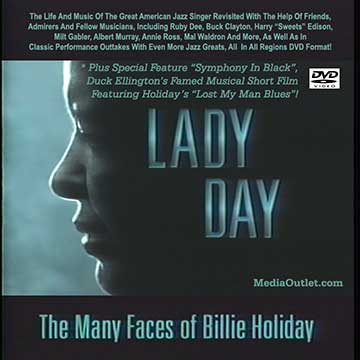
November 24, 1912: #BOTD: #HBD: Teddy
Wilson, African American swing jazz bandleader and pianist who
recorded many of the most important jazz records, and peformed in
many of the most important jazz performances (d. July 31, 1986) is
#born Theodore Shaw Wilson in Austin, Texas, and studied piano and
violin at Tuskegee Institute in Tuskegee, Alabama. Wilson had a
sophisticated, elegant style that was featured on the records of
many of the biggest names in jazz, including Louis Armstrong,
Benny Goodman, Billie Holiday, Ella Fitzgerald, Lena Horne, Lester
Young, Gene Krupa, Lionel Hampton and many others. With Goodman,
he was one of the first black musicians to appear prominently with
white musicians. In addition to his extensive work as a sideman,
Wilson also led his own groups and recording sessions from the
late 1920s to the 1980s. Teddy Wilson died of stomach cancer in
New Britain, Connecticut, aged 73. He is buried at Fairview
Cemetery in New Britain. On Sale @ 15% Off Discount Till Midnight
PT!
https://store.earthstation1.com/lady-day-the-many-faces-of-billie-holiday-dvd-plus-bonus.html
Today's
EarthStation1.com 15% Off Commemorative Memorial Title: Firing
Line Special: The Kennedy-Macmillan Relationship DVD, MP4, USB
Today, November 24, 2025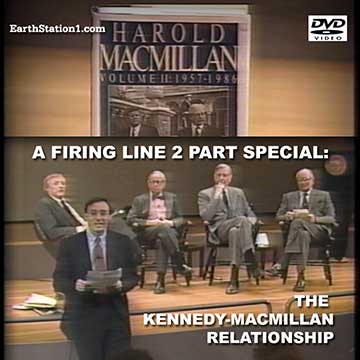
November 24, 1925: #BOTD: William F.
Buckley, Jr., American conservative public intellectual,
journalist, author, publisher, and political commentator, founder
of the National Review magazine (d. February 27, 2008) is #born
William Francis Buckley in New York City. He founded National
Review magazine in 1955, which had a major impact in stimulating
the conservative movement; hosted 1,429 episodes of the television
show Firing Line (1966-1999), where he became known for his
transatlantic accent and wide vocabulary; and wrote a nationally
syndicated newspaper column along with numerous spy novels.
Buckley's primary contribution to politics was a fusion of
traditional American political conservatism with laissez-faire
economic theory and anti-communism, laying the groundwork for the
new American conservatism of presidential candidate Barry
Goldwater and President Ronald Reagan, both Republicans. Former
Senate Republican leader Bob Dole said "Buckley lighted the
fire". Buckley wrote God and Man at Yale (1951) and more than
fifty other books on writing, speaking, history, politics, and
sailing, including a series of novels featuring CIA agent
Blackford Oakes. Buckley referred to himself as either a
libertarian or conservative. William F. Buckley, Jr. died of a
heart attack in his study at his home in Stamford, Connecticut, at
the age of 82. Buckley is buried at the Saint Bernard Cemetery in
Sharon, Connecticut, next to his wife, Patricia. On Sale @ 15% Off
Discount Till Midnight PT!
https://store.earthstation1.com/firing-line-special-the-kennedymacmillan-relationship-dvd-mp4-usbht4.html
Today's
EarthStation1.com 15% Off Commemorative Memorial Title: Rock &
Roll An Unruly History 10 Part TV Series MP4 Video Download DVD
Today, November 24, 2025
November 24, 1941: #BOTD: #HBD! Donald
"Duck" Dunn, American bass guitarist, session musician,
record producer, and songwriter (d. May 13, 2012) is #born in
Memphis, Tennessee. His father nicknamed him "Duck"
while watching Disney cartoons with him one day. Dunn grew up
playing sports and riding his bike with another future
professional musician partner, Steve Cropper. He was notable for
his 1960s recordings with Booker T. and the M.G.'s and as a
session bassist for Stax Records. At Stax, Dunn played on
thousands of records, including hits by Otis Redding, Sam and
Dave, Rufus Thomas, Carla Thomas, William Bell, Eddie Floyd,
Johnnie Taylor, Albert King, Elvis Presley and many others. In
1992, he was inducted in The Rock And Roll Hall Of Fame as a
member of Booker T. and the M.G.'s. He is ranked number 40 on Bass
Player magazine's list of "The 100 Greatest Bass Players of
All Time". Duck Dunn died in his sleep in the morning at age
70 after finishing his fifth double show at the Blue Note
nightclub in Tokyo with Cropper the night before. He had been in
Japan as part of an ongoing tour with Cropper and Eddie Floyd. He
is buried in Memorial Park Cemetery in Memphis, Tennessee. On Sale
@ 15% Off Discount Till Midnight PT!
https://store.earthstation1.com/rock-amp-roll-an-unruly-history-10-part-tv-series-mp4-video-download-104.html
Today's
EarthStation1.com 15% Off Commemorative Memorial Title: Air Power
WWII TV Series With Walter Cronkite DVD, Video Download, USB
Today, November 24, 2025
November 24, 1944: World War II: The
Pacific War (The Asia-Pacific War, The Asiatic-Pacific Theater,
The Pacific Theater Of World War II): The Asiatic-Pacific Theater:
Aviation: Military Aviation: Air Warfare Of World War II: Air
Warfare Of The Pacific War: Air Raids On Japan: The Bombing Of
Tokyo (Japanese: Tokyodaikushu): The B-29 Raids From The Northern
Mariana Islands: -- The American 73rd Bombardment Wing (Very
Heavy), flying the newly-deployed state-of-the-art Boeing B-29
Superfortress heavy bomber, launches the first of almost ceaseless
attacks on Tokyo from the Northern Mariana Islands. The deployment
was a military and psychological shock to Japan, who came to see
it as a sign of their eventual defeat. At first, poor weather, the
lack of precision radar bombing equipment, and tremendous winds
encountered at high altitudes over Japan made accuracy difficult
and the raids achieved only moderate success. The initial raids
against Japan had taken place at high altitudes in order to stay
above anti-aircraft fire and the effective altitude of defending
fighters. However, tactics were changed, and high-altitude,
daylight attacks were phased out and replaced by low-altitude,
high-intensity incendiary raids at nighttime. The aircraft would
attack individually, which meant that no assembly over the base at
the start of the mission or along the way would be needed.
Consequently, it turned to devastating low altitude incendiary
attacks. Firebombing cut the city's industrial output in half. As
over half of Tokyo's industry was spread out among residential and
commercial neighborhoods, some analysts have called the raids a
war crime due to the mass targeting of civilian infrastructure and
ensuing large-scale loss of civilian life. The wing continued
attacking urban areas until the end of the war in August 1945, its
subordinate units conducted raids against strategic objectives,
bombing aircraft factories, chemical plants, oil refineries, and
other targets in Japan. The wing flew its last combat missions on
August 14, when hostilities ended. Afterwards, the wing's B 29s
carried relief supplies to Allied prisoner of war camps in Japan
and Manchuria. On Sale @ 15% Off Discount Till Midnight PT!
https://store.earthstation1.com/air-power-original-1950s-tv-series-walter-cronkite-4-dv19504.html
Today's
EarthStation1.com 15% Off Commemorative Memorial Title: Ruby And
Oswald 1978 TV Docudrama JFK Assassination DVD, Download, USB
Today, November 24, 2025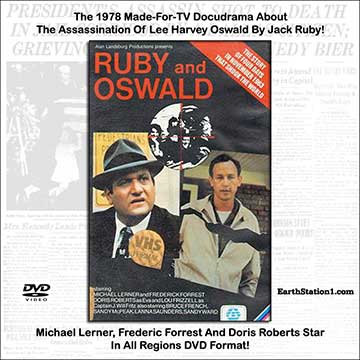
November 24, 1963: United States
Presidential Assassination Attempts And Plots: United States
Presidential Assassinations: The Assassination Of John F. Kennedy:
-- #DOTD: In the first live, televised murder, Lee Harvey Oswald,
alleged lone assassin of President John F. Kennedy, is himself
murdered two days after by Jack Ruby, a mafia connected nightclub
operator, in the basement of Dallas police department
headquarters, while oswald was being led by two detectives to an
armoured car to take him to the nearby county jail. Ruby drove
into town that day with his pet dachshund Sheba (whom he would
often jokingly refer to as his "wife") to send an
emergency money order at the Western Union on Main Street to one
of his employees. The time stamp of completion for the cash
transaction on the money order was 11:17 a.m. Ruby then walked one
half block to the nearby Dallas police headquarters, where he made
his way into the basement via either the Main Street ramp or a
stairway accessible from an alleyway next to the Dallas Municipal
Building. At 11:21 a.m. CST-while authorities were escorting
Oswald through the police basement to an armored car that was to
take him to the nearby county jail-Ruby emerged from a crowd of
reporters with his .38 Colt Cobra revolver aimed at Oswald's
abdomen and shot him at point blank range, mortally wounding him.
The bullet entered Oswald's left side in the front part of the
abdomen and caused damage to his spleen, stomach, aorta, vena
cava, kidney, liver, diaphragm, and eleventh rib before coming to
rest on his right side. Oswald made a cry of anguish and his
manacled hands clutched at his abdomen as he writhed with pain,
and he slumped to the concrete paving, where he moaned several
times. Police detective Billy Combest who recognized Ruby
exclaimed: "Jack, you son of a bitch!" Ruby was
immediately subdued by police as a moaning Oswald was carried back
into the basement level jail office. Combest asked Oswald, "Do
you have anything you want to tell us now?" Oswald shook his
head. He lost consciousness shortly thereafter. Taken by ambulance
to Parkland Memorial Hospital -- the same hospital where President
Kennedy had died two days earlier -- Oswald died at 1:07 p.m. The
crowd outside the headquarters burst into applause when they heard
that Oswald had been shot. A network television pool camera was
broadcasting live to cover the transfer; millions of people
watching on NBC witnessed the shooting as it happened and on other
networks within minutes afterward. Several photographs were taken
of the event just before, as, and after Ruby pulled the trigger.
In 1964, Robert H. Jackson of the Dallas Times Herald was awarded
the Pulitzer Prize for Photography for his image of the shooting
of Lee Harvey Oswald by Jack Ruby. Lee Harvey Oswald is buried at
Shannon Rose Hill Memorial Park in Fort Worth, Texas. Lee Harvey
Oswald, American assassin of John F. Kennedy (b. October 18, 1939)
was born at the old French Hospital in New Orleans, Louisiana. He
was an American former U.S. Marine who has been blamed for having
assassinated United States President John F. Kennedy on November
22, 1963. According to four federal government investigations, one
municipal investigation, and a mock docu-trial, Oswald shot and
killed Kennedy as the President traveled by motorcade through
Dealey Plaza in the city of Dallas, Texas. Oswald was honorably
discharged from the Marine Corps and defected to the Soviet Union
in October 1959. He lived in the Belarusian city of Minsk until
June 1962, at which time he returned to the United States with
Marina, his Russian-born wife, eventually settling in Dallas.
Following the fatal shooting of Kennedy, Oswald was initially
arrested for the murder of police officer J. D. Tippit, who was
killed on a Dallas street about 45 minutes after Kennedy was shot.
Oswald was later charged with the murder of Kennedy. He denied
shooting anybody, saying that he was a "patsy". In
September 1964, the Warren Commission released it findings and
concluded that Oswald acted alone in assassinating Kennedy by
firing three shots from the Texas School Book Depository. This
conclusion was supported by previous investigations carried out by
the FBI, the Secret Service, and the Dallas Police Department.
Nevertheless, there is much evidence to indicate that others were
involved in the plot to kill the president, some of whom of which
Oswald was involved with. On Sale @ 15% Off Discount Till Midnight
PT!
https://store.earthstation1.com/ruby-and-oswald-dvd-michael-lerner-frederic-forrest.html
Today's
EarthStation1.com 15% Off Commemorative Memorial Title: Vietnam
War Films & Documentaries Collection DVD, Download, USB Drive
Today, November 24, 2025
November 24, 1969: The Aftermath Of World
War II: The Cold War: The Cold War In Asia: The Indochina Wars:
The Vietnam War (The Second Indochina War, The Vietnam Conflict,
The Resistance War Against America): The United States In The
Vietnam War: War Crimes: War Crimes Of The Vietnam War: The My Lai
Massacre (The Pinkville Massacre, The Massacre At Songmy, Son My
Massacre): -- The U.S. Army announces that Lt. William L. Calley
has been charged with premeditated murder in the massacre of
civilians in the Vietnamese village of My Lai in March of 1968.
Calley was ordered to stand trial by court martial and was later
convicted and sentenced to life in prison. However, his sentence
was later commuted to three years of house arrest by President
Richard Nixon. The My Lai Massacre, the Vietnam War mass killing
of between 347 and 504 unarmed Vietnamese civilians in South
Vietnam on March 16, 1968, was committed by U.S. Army soldiers
from Company C, 1st Battalion, 20th Infantry Regiment, 11th
Brigade, 23rd (Americal) Infantry Division. Victims included men,
women, children, and infants. Some of the women were gang-raped
and their bodies mutilated. Twenty-six soldiers were charged with
criminal offenses, but only Lieutenant William Calley Jr., a
platoon leader in C Company, was convicted. Found guilty of
killing 22 villagers, he was originally given a life sentence, but
served only three and a half years under house arrest. The
massacre, which was later called "the most shocking episode
of the Vietnam War", took place in two hamlets of Son My
village in Quang Ngai Province. These hamlets were marked on the
U.S. Army topographic maps as My Lai and My Khe. The U.S. Army
slang name for the hamlets and sub-hamlets in that area was
Pinkville, and the carnage was initially referred to as the
Pinkville Massacre. Later, when the U.S. Army started its
investigation, the media changed it to the Massacre at Songmy.
Currently, the event is referred to as the My Lai Massacre in the
United States and called the Son My Massacre in Vietnam. The
incident prompted global outrage when it became public knowledge
as a result of Hersh's story. The My Lai massacre increased
domestic opposition to the U.S. involvement in the Vietnam War
when the scope of killing and cover-up attempts were exposed.
Initially, three U.S. servicemen who had tried to halt the
massacre and rescue the hiding civilians were shunned, and even
denounced as traitors by several U.S. Congressmen, including
Mendel Rivers, Chairman of the House Armed Services Committee.
Only after thirty years were they recognized and decorated, one
posthumously, by the U.S. Army for shielding non-combatants from
harm in a war zone. Along with the No Gun Ri massacre in Korea
eighteen years earlier, My Lai was one of the largest single
massacres of civilians by U.S. forces in the 20th century. On Sale
@ 15% Off Discount Till Midnight PT!
https://store.earthstation1.com/vietnam-war-films-2-dual-layer--dvd-se2.html
Today's
EarthStation1.com 15% Off Commemorative Memorial Title: Skull
Wars: The Missing Link Controversy MP4 Video Download DVD
Today, November 24, 2025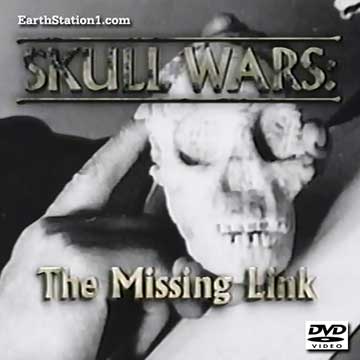
November 24, 1974: Anthropology:
Paleoanthropology: Human Evolution: Lucy (Australopithecus) (AL
288-1, Dink'inesh, [Amharic: "You Are Marvellous"]: --
Donald Johanson and Tom Gray discover the 40% complete
Australopithecus Afarensis skeleton, nicknamed "Lucy"
(after The Beatles song "Lucy In The Sky with Diamonds",
which was playing when they discovered her), in the Awash Valley
of Ethiopia's Afar Depression. Australopithecus afarensis is an
extinct species of australopithecine which lived from about
3.9-2.9 million years ago (mya) in the Pliocene of East Africa.
The first fossils were discovered in the 1930s, but major fossil
finds would not take place until the 1970s. From 1972 to 1977, the
International Afar Research Expedition-led by anthropologists
Maurice Taieb, Donald Johanson and Yves Coppens-unearthed several
hundreds of hominin specimens in Hadar, Ethiopia, the most
significant being the exceedingly well-preserved skeleton AL 288-1
("Lucy") and the site AL 333 ("the First Family").
Beginning in 1974, Mary Leakey led an expedition into Laetoli,
Tanzania, and notably recovered fossil trackways. In 1978, the
species was first described, but this was followed by arguments
for splitting the wealth of specimens into different species given
the wide range of variation which had been attributed to sexual
dimorphism (normal differences between males and females). A.
afarensis probably descended from A. anamensis and is hypothesised
to have given rise to Homo, though the latter is debated. A.
afarensis had a tall face, a delicate brow ridge, and prognathism
(the jaw jutted outwards). The jawbone was quite robust, similar
to that of gorillas. The living size of A. afarensis is debated,
with arguments for and against marked size differences between
males and females. Lucy measured perhaps 105 cm (3 ft 5 in) in
height and 25-37 kg (55-82 lb), but she was rather small for her
species. In contrast, a presumed male was estimated at 165 cm (5
ft 5 in) and 45 kg (99 lb). A perceived difference in male and
female size may simply be sampling bias. The leg bones as well as
the Laetoli fossil trackways suggest A. afarensis was a competent
biped, though somewhat less efficient at walking than humans. The
arm and shoulder bones have some similar aspects to those of
orangutans and gorillas, which has variously been interpreted as
either evidence of partial tree-dwelling (arboreality), or basal
traits inherited from the chimpanzee-human last common ancestor
with no adaptive functionality. A. afarensis was probably a
generalist omnivore of both C3 forest plants and C4 CAM savanna
plants-and perhaps creatures which ate such plants-and was able to
exploit a variety of different food sources. Similarly, A.
afarensis appears to have inhabited a wide range of habitats with
no real preference, inhabiting open grasslands or woodlands,
shrublands, and lake- or riverside forests. Potential evidence of
stone tool use would indicate meat was also a dietary component.
Marked sexual dimorphism in primates typically corresponds to a
polygynous society and low dimorphism to monogamy, but the group
dynamics of early hominins is difficult to predict with accuracy.
Early hominins may have fallen prey to the large carnivores of the
time, such as big cats and hyenas. On Sale @ 15% Off Discount Till
Midnight PT! https://store.earthstation1.com/skwamilicomp.html
Today's
EarthStation1.com #OnThisDay Commemorative Memorial Title: TV
Commercials: The Classics Vol. 3 DVD, Video Download, USB Drive
Today, November 24, 2025 November 24: National Fairy Bread Day: --
A whimsical delight, this colorful creation sprinkles joy on
slices of buttered bread, transforming ordinary moments into
magical bites! Each annual celebration of Fairy Bread Day brings
new opportunities for individuals, families and communities to get
involved with celebrating this delightful childhood treat. Get
some soft white bread, slather on some butter and pile on the
jimmies, sprinkles, hundreds and thousands or whatever other name
there is for this fun little candy goodness! In 2014, Adam Schell
was eating a piece of fairy bread and, deeply satisfied, joked
that "there should be a day to celebrate this". His
friend encouraged him to found a day and now it has been going on
annually for a decade! Choosing the date for the celebration was
easy, as the day Schell made his remark was on November 24. Fairy
Bread Day was established as a way to delight in the simple things
of life, specifically what Australians and New Zealanders would
refer to as "fairy bread". While it might sound like an
elusive treat, it's really just made by spreading butter or
margarine on slices of white bread and covering it with sprinkles
or "hundreds and thousands" as they are known down under
and in the UK. The day is sponsored by Australian company, Dollar
Sweets, maker of all sorts of sprinkles and candy toppings. After
being celebrated for a few years, the forces behind Fairy Bread
Day decided it would be beneficial to include an opportunity to
make the world a better place through its events. In 2020, Fairy
Bread Day announced a partnership with an online mental health
service called ReachOut, creating an opportunity to raise more
than 80K USD in funds over three years to support struggling youth
of Australia. 2023 brought a new partnership between Fairy Bread
Day and The Pyjama Foundation, which is an organization that
focuses on helping to equip children who are in foster homes. So
eat some fairy bread and make a difference in honor of this day!
So reach back into those delightful childhood memories to bring up
some happy feelings and nostalgia over this delicious treat!
https://store.earthstation1.com/tv-commercials-the-classics-vol-3-dv3.html
November 24: National Fairy Bread Day: --
A whimsical delight, this colorful creation sprinkles joy on
slices of buttered bread, transforming ordinary moments into
magical bites! Each annual celebration of Fairy Bread Day brings
new opportunities for individuals, families and communities to get
involved with celebrating this delightful childhood treat. Get
some soft white bread, slather on some butter and pile on the
jimmies, sprinkles, hundreds and thousands or whatever other name
there is for this fun little candy goodness! In 2014, Adam Schell
was eating a piece of fairy bread and, deeply satisfied, joked
that "there should be a day to celebrate this". His
friend encouraged him to found a day and now it has been going on
annually for a decade! Choosing the date for the celebration was
easy, as the day Schell made his remark was on November 24. Fairy
Bread Day was established as a way to delight in the simple things
of life, specifically what Australians and New Zealanders would
refer to as "fairy bread". While it might sound like an
elusive treat, it's really just made by spreading butter or
margarine on slices of white bread and covering it with sprinkles
or "hundreds and thousands" as they are known down under
and in the UK. The day is sponsored by Australian company, Dollar
Sweets, maker of all sorts of sprinkles and candy toppings. After
being celebrated for a few years, the forces behind Fairy Bread
Day decided it would be beneficial to include an opportunity to
make the world a better place through its events. In 2020, Fairy
Bread Day announced a partnership with an online mental health
service called ReachOut, creating an opportunity to raise more
than 80K USD in funds over three years to support struggling youth
of Australia. 2023 brought a new partnership between Fairy Bread
Day and The Pyjama Foundation, which is an organization that
focuses on helping to equip children who are in foster homes. So
eat some fairy bread and make a difference in honor of this day!
So reach back into those delightful childhood memories to bring up
some happy feelings and nostalgia over this delicious treat!
https://store.earthstation1.com/tv-commercials-the-classics-vol-3-dv3.html
Today's
EarthStation1.com #OnThisDay Commemorative Memorial Title: Andy
Warhol (1987) Documentary Mel Melvyn Bragg MP4 Video Download DVD
Today, November 24, 2025November 24: Celebrate Your Unique Talent
Day: -- A day to accept and celebrate individual talents. Beauty
lies in being different. We're not made to all fit in one box.
Celebrate Your Unique Talent Day is a day to accept these
differences and to love what each of us has to offer. Can you
stand on your hands, curl your tongue, do uncanny impressions? Are
you a prolific whistler, graffiti artist, or double-jointed?
Whatever it may be, celebrate your talent today. No actual
historical timeline exists when it comes to talents. People have
had their unique talents for as long as they have existed. Sure,
more conventional talents may have come into existence a little
later; for example, being a gifted guitarist was only possible
after the invention of the guitar. But other quirky talents have
been around since day one, and we don't know where we'd be without
them. Is it too far-fetched to think that the world would be a
different place without special skills and talents? We wouldn't
know light if it wasn't for the guy whose unique talent was
rubbing sticks together until they sparked. Music would sound so
different if it wasn't for the person whose unique talent was
creating sounds from flat hollow surfaces, eventually leading to
the invention of drums. Talents don't even have to be
revolutionary to be celebrated. Even being able to touch your
tongue to your nose is great, unique to you, and deserves to be
hyped up! As PGA Master Dr. Alison Curdt is quoted to have said,
"Being different is a strength, not a weakness." Society
has shut it down in the past, but we are progressively becoming
more accepting and inclusive. Not everyone is born to be a singer
or dancer, some people are gifted to bend their thumb all the way
back, and they deserve recognition too. As a matter of fact, the
true celebration doesn't even lie in external validation. Do you
think the first person to rub wooden sticks together didn't get
weird looks from his friends? What would have happened if he let
that judgment get to him and stopped exploring his talent?
Accepting your inherent uniqueness is powerful in more ways than
one. Celebrate Your Unique Talent Day is a reminder of just that.
https://store.earthstation1.com/anwa1domelme.html
Today's
EarthStation1.com #OnThisDay Commemorative Memorial Title: Rhythm
And Blues Revue (1955) DVD, MP4 Video Download, USB Flash Drive
Today, November 24, 2025(NOTE: #JCKaelin here: My father's life
was rocked (and rolled) when he first heard Big Joe Turner's
"Shake, Rattle And Roll" play on the radio as an
eighteen-year-old in 1954. It confirmed him as a rock and roll fan
in general, and of authentic black rhythm and blues in particular.
He understood the risque lyrics for what they were, and so, she
thought, did his mother. After he succeeded in purchasing a 78 RPM
record of the song by mail, she heard him play it, burst into his
room, and broke it, exclaiming "I know what those lyrics
mean! He's really singing "Shake Marilyn Monroe!" She
may not have been far wrong, as the text in the listing below
shows, but her reaction was a great example of how many white
parents reacted to the black music their children were beginning
to listen to at the time ;) ) ========= November 24, 1985: #DOTD:
#RIP: Big Joe Turner, African American blues shouter, rhythm and
blues/jazz singer from Kansas City, Missouri (b. May 18, 1911)
#dies of heart failure iat the age of 74 in Inglewood, California,
having suffered from effects of arthritis, a stroke and diabetes.
He is buried at Roosevelt Memorial Park in Gardena, California. He
was born Joseph Vernon Turner Jr in Kansas City, Missouri.
According to songwriter Doc Pomus, "Rock and roll would have
never happened without him." His greatest fame was due to his
rock-and-roll recordings in the 1950s, particularly his landmark
"Shake, Rattle and Roll", but his career as a performer,
particularly as a jazz singer in Kansas City, endured from the
1920s into the 1980s. Turner was inducted into The Rock And Roll
Hall Of Fame in 1987, with the Hall lauding him as "the
brawny voiced 'Boss of the Blues'". Shake, Rattle and Roll
was rock and roll's breakthrough song to the general public. It is
a twelve bar blues-form song, written in 1954 by Jesse Stone under
his songwriting pseudonym of Charles E. Calhoun. In early 1954,
Ahmet Ertegun of Atlantic Records suggested to Stone that he write
an up-tempo blues for Turner. Stone played around with various
phrases before coming up with "shake, rattle and roll".
However, the phrase had been used in earlier songs. In 1910,
vaudeville performer "Baby" Franklin Seals published
"You Got to Shake, Rattle and Roll", a ragtime tune
about gambling with dice, in New Orleans; in 1919, Al Bernard
recorded a version of the song. The phrase is also heard in "Roll
the Bones" by the Excelsior Quartette in 1922. Turner's
version was recorded in New York City on February 15, 1954. The
shouting chorus on his version consisted of Jesse Stone, and
record label executives Jerry Wexler and Ahmet Ertegun. The
saxophone solo was by Sam "The Man" Taylor. Other
players included McHouston "Mickey" Baker ("Love is
Strange") on guitar and drummer Connie Kay (later from the
Modern Jazz Quartet). Turner's recording was released in April
1954, reached number one on the U.S. Billboard R & B chart on
June 12, did not move for three weeks, and peaked at number 22,
nearly at the same time, on the Billboard pop chart (subsequently
billed as the Billboard Hot 100). The song, in its original
incarnation, is highly sexual. Perhaps its most salacious lyric,
which was absent from the later Bill Haley rendition, is "I've
been holdin' it in, way down underneath / You make me roll my
eyes, baby, make me grit my teeth". On the recording, Turner
slurred the lyric "holdin' it in", since this line may
have been considered too risque for publication. The chorus used
"shake, rattle and roll" to refer to boisterous
intercourse, in the same way that the words "rock and roll"
were first used by numerous rhythm and blues singers, starting
with Trixie Smith's "My Man Rocks Me (With One Steady Roll)"
in 1922, and continuing on prominently through the 1940s and
1950s. Stone stated that the line about "a one-eyed cat
peepin' in a seafood store" was suggested to him by Atlantic
session drummer Sam "Baby" Lovett, which is also a sly
sexual reference, the "one-eyed cat" being the male
organ and the more traditional "seafood" reference being
the female organ.
https://store.earthstation1.com/rhythm-and-blues-revue-dvd-1955-apollo-theater-tv-1955.html
Today's
EarthStation1.com #OnThisDay Commemorative Memorial Title:
Offshore Pirate Radio 1960s-1980s MP3s DVD, Audio Download, USB
Drive
Today, November 24, 2025November 24, 1941: #BOTD: #HBD! Pete
Best, English musician who was the drummer for The Beatles from
1960 to 1962, dismissed immediately prior to the band achieving
worldwide fame and one of several people who have been referred to
as a fifth Beatle, is #born Randolph Peter Scanland in Madras,
British India. Best's mother, Mona Best (1924-1988), opened the
Casbah Coffee Club in the cellar of the Bests' house in Liverpool.
The Beatles (at the time known as the Quarrymen) played some of
their first concerts at the club. The Beatles invited Best to join
the band on August 12, 1960, on the eve of the group's first
Hamburg season of club dates. Ringo Starr eventually replaced Best
on August 16, 1962 when the group's manager, Brian Epstein, fired
Best at the request of John Lennon, Paul McCartney, and George
Harrison following the band's first recording session. Over 30
years later, Best received a major monetary payout for his work
with the Beatles after the release of their 1995 compilation of
their early recordings on Anthology 1; Best played the drums on 10
of the album's tracks, including the Decca auditions. After
working in several commercially unsuccessful groups, Best gave up
being in the music industry to work as a civil servant for 20
years before starting the Pete Best Band.
https://store.earthstation1.com/offshore-pirate-radio-2-dual-layer-mp3-dvds-uk-amp-euro23.html
Today's
EarthStation1.com #OnThisDay Commemorative Memorial Title:
Offshore Pirate Radio 1960s-1980s MP3s DVD, Audio Download, USB
Drive
Today, November 24, 2025November 24, 1991: #DOTD: #RIP: Freddie
Mercury, Tanzanian-English singer, songwriter, and producer, lead
vocalist, pianist and frontman of the English rock band Queen,
regarded as one of the greatest singers in the history of rock
music, known for his flamboyant stage persona and four-octave
vocal range (b. September 5, 1946) #dies in the evening in his
Kensington, West London, England home at the age of 45 of
bronchial pneumonia resulting from AIDS, after having kept the
state of his health a strict secret from all but a few people and
his bandmates for years. Two days prior, on November 22, 1991,
Mercury called Queen's manager Jim Beach to his Kensington home to
prepare a public statement, which was released the following day,
about 24 hours before his death: "Following the enormous
conjecture in the press over the last two weeks, I wish to confirm
that I have been tested HIV positive and have AIDS. I felt it
correct to keep this information private to date to protect the
privacy of those around me. However, the time has come now for my
friends and fans around the world to know the truth and I hope
that everyone will join with me, my doctors and all those
worldwide in the fight against this terrible disease. My privacy
has always been very special to me and I am famous for my lack of
interviews. Please understand this policy will continue." His
close friend Dave Clark of the Dave Clark Five was at the bedside
vigil when Mercury died. Mercury's first partner and close
confidante Mary Austin phoned Mercury's parents and sister to
break the news, which reached newspaper and television crews in
the early hours of November 25. The outer walls of Mercury's final
home, Garden Lodge, Logan Place, west London, became a shrine to
the late singer. Mercury's funeral service was conducted on
November 27, 1991 by a Zoroastrian priest at West London
Crematorium, where he is commemorated by a plinth (pedestal) under
his birth name, Farrokh Bulsara. In attendance at Mercury's
service were his family and 35 of his close friends, including
Elton John and the members of Queen. His coffin was carried into
the chapel to the sounds of "Take My Hand, Precious
Lord"/"You've Got a Friend" by Aretha Franklin. In
accordance with Mercury's wishes, Mary Austin took possession of
his cremated remains and buried them in an undisclosed location.
The whereabouts of his ashes are believed to be known only to
Austin, who has said that she will never reveal them. However,
they are traditionally held by Queen fans to be at Kensal Green
Cemetery in the Kensal Green area of North Kensington, where the
plinth marks the supposed burial location. Mercury spent and
donated to charity much of his wealth during his lifetime, with
his estate valued around _8 million at the time of his death. He
bequeathed his home, Garden Lodge, and the adjoining Mews, as well
as 50% of all privately owned shares, to Mary Austin. Freddie
Mercury was born Farrokh Bulsara in Stone Town in the British
protectorate of Zanzibar (now part of Tanzania). His parents, Bomi
and Jer Bulsara, were from the Parsi community of western India.
The Bulsaras had origins in the city of Bulsar (now Valsad) in
Gujarat. He had a younger sister, Kashmira (b. 1952). Mercury
attended British boarding schools in India from the age of eight
and returned to Zanzibar after secondary school. In 1964, his
family fled the Zanzibar Revolution, moving to Middlesex, England.
Having previously studied and written music, he formed Queen in
1970 with guitarist Brian May and drummer Roger Taylor. Mercury
wrote numerous hits for Queen, including "Killer Queen",
"Bohemian Rhapsody", "Somebody to Love", "We
Are the Champions", "Don't Stop Me Now" and "Crazy
Little Thing Called Love". His charismatic stage performances
often saw him interact with the audience, as displayed at the 1985
Live Aid concert. He also led a solo career and was a producer and
guest musician for other artists. Mercury defied the conventions
of a rock frontman with his theatrical style, influencing the
artistic direction of Queen and the course of rock music
thereafter. Mercury was diagnosed with AIDS in 1987. He continued
to record with Queen, and was posthumously featured on their final
album, Made in Heaven (1995). In 1991, the day after publicly
announcing his diagnosis, he died from complications of the
disease at the age of 45. In 1992, a concert in tribute to him was
held at Wembley Stadium, in benefit of AIDS awareness. As a member
of Queen, Mercury was posthumously inducted into the Rock and Roll
Hall of Fame in 2001, the Songwriters Hall of Fame in 2003, and
the UK Music Hall of Fame in 2004. In 1990, he and the other Queen
members received the Brit Award for Outstanding Contribution to
British Music. One year after his death, Mercury received the same
award individually. In 2005, Queen were awarded an Ivor Novello
Award for Outstanding Song Collection from the British Academy of
Songwriters, Composers, and Authors. In 2002, Mercury was voted
number 58 in the BBC's poll of the 100 Greatest Britons.
https://store.earthstation1.com/offshore-pirate-radio-2-dual-layer-mp3-dvds-uk-amp-euro23.html
Today's
EarthStation1.com #OnThisDay Commemorative Memorial Title: I Want
My Music TV! 1980s Music Videos DVD, MP4 Download, USB Drive
Today, November 24, 2025November 24, 1955: #BOTD: #HBD! Clem
Burke, American musician best known as the drummer for the band
Blondie from 1975, shortly after the band formed, and throughout
the band's entire career (d. April 6, 2025) is #born Clement
Anthony Bozewski in Bayonne, New Jersey, where he grew up at 66
Evergreen Street. He also played drums for the Ramones for a brief
time in 1987, and performed under the name "Elvis Ramone".
Burke's early experiences behind the drum kit began in the late
1960s and early 1970s as one of the founding members of Bayonne's
premier cover bands, Total Environment and Sweet Willie Jam Band.
Burke also gained percussion knowledge from his stint as a drummer
in the famed Saint Andrew Bridgmen Drum and Bugle Corps in
Bayonne. Recruited by Debbie Harry and Chris Stein when Blondie
was first forming in 1974, Burke joined Blondie in 1975. He was a
key figure in keeping the group together after Stein and Harry
considered disbanding, following the departure of original bassist
Fred Smith to Television and recruited his friend Gary Valentine
to play bass. His style of playing was influenced by Hal Blaine,
Keith Moon, Ringo Starr, and Earl Palmer. Clem Burke died from
cancer at age 70. The location of where he died and his burial
details are not publicly disclosed.
https://store.earthstation1.com/i-want-my-music-tv-dvd-late-1980s-vi1980.html
Today's
EarthStation1.com #OnThisDay Commemorative Memorial Title: Babes
In Toyland 1986 Keanu Reeves Drew Barrymore DVD, MP4, USB Drive
Today, November 24, 2025November 24, 2005: #DOTD: #RIP: Pat
Morita, Japanese American actor, voice actor, comedian, and
martial artist (b. June 28, 1932) #dies of kidney failure at his
home in Las Vegas, Nevada at the age of 73. He was survived by
Evelyn Guerrero (best known for portraying "Donna" in
three Cheech and Chong movies and the first Latina to pose in 1980
in "Playboy" magazine), his wife for 11 years, and three
daughters from his previous marriage. He was cremated at Palm
Green Valley Mortuary and Cemetery in Las Vegas, Nevada, and the
ashes were given to his widow Evelyn Guerrero. Born Noriyuki
Morita in Isleton, California, he was known for his roles as
Matsuo "Arnold" Takahashi on Happy Days (1975-1983), Mr.
Miyagi in The Karate Kid film series, Mike Woo in The Mystery
Files of Shelby Woo, and The Emperor of China in Mulan and Mulan
II. Morita was nominated for the 1985 Academy Award for Best
Supporting Actor for his portrayal of Mr. Miyagi in The Karate
Kid. Morita also portrayed Ah Chew in Sanford and Son (1974-1976).
Morita was the series lead actor in the television program Mr. T
and Tina (1976) and in Ohara (1987-1988), a police-themed drama.
The two shows made history for being among the few TV shows with
an Asian American series lead. Morita developed spinal
tuberculosis (Pott disease) at the age of two and spent the bulk
of the next nine years in the Weimar Institute in Weimar,
California, and later at the Shriners Hospital in San Francisco.
For long periods he was wrapped in a full-body cast and was told
that he would never walk. During his time at a sanatorium near
Sacramento, Morita befriended a visiting priest who would often
joke that, if Morita ever converted to Catholicism, the priest
would rename him to "Patrick Aloysius Ignatius Xavier
Noriyuki Morita". Released from the hospital at age 11 after
undergoing extensive spinal surgery and learning how to walk,
Morita was transported from the hospital directly to the Gila
River camp in Arizona to join his interned family. After about a
year and a half, he was transferred to the Tule Lake War
Relocation Center. For a time after the war, the family operated
Ariake Chop Suey, a restaurant in Sacramento, California. Morita
would entertain customers with jokes and serve as master of
ceremonies for group dinners. Morita began working as a stand-up
comic after graduating from Armijo High School in Fairfield,
California. He took the stage name "Pat Morita", in part
due to the presence of comedians including Pat Henry and Pat
Cooper, and in part due to memories of the priest he had
befriended as a boy. Morita struggled for many years in comedy.
Sally Marr, Lenny Bruce's mother, acted as his agent and manager
in his early days. Morita sometimes worked as the opening act for
singers Vic Damone and Connie Stevens and for his mentor, the
comedian Redd Foxx. Foxx later gave him a role on his sitcom
Sanford and Son in the early 1970s. Morita's first movie roles
were as a henchman in Thoroughly Modern Millie (1967) and a
similar role in The Shakiest Gun In The West (1968), starring Don
Knotts. Later, a recurring role as South Korean Army Captain Sam
Pak on the sitcom M*A*S*H (1973, 1974) helped advance the
comedian's acting career. He also was cast as Rear Admiral
Ryunosuke Kusaka in the war film Midway (1976). He had a recurring
role on the show Happy Days as Matsuo "Arnold"
Takahashi, owner of the diner Arnold's for the show's third season
(1975-1976) and made guest appearances in 1977 and 1979. After the
season's end, he left the show to star as inventor Taro Takahashi
in his own show Mr. T and Tina, the first Asian-American sitcom on
network TV. The sitcom was placed on Saturday nights by ABC and
was quickly canceled after a month in the fall of 1976. Morita
revived the character of Arnold on Blansky's Beauties in 1977 and
eventually returned to Happy Days for the 1982-1983 season. Morita
had another notable recurring television role on Sanford and Son
(1974-1976) as Ah Chew, a good-natured friend of Lamont Sanford.
Morita gained particular fame playing wise karate teacher Mr.
Miyagi, who taught young "Daniel-san" (Ralph Macchio)
the art of Goju-ryu karate in The Karate Kid. He was nominated for
an Academy Award for Best Supporting Actor and a corresponding
Golden Globe Award, reprising his role in three sequels: The
Karate Kid Part II (1986), The Karate Kid Part III (1989) and The
Next Karate Kid (1994), the last of which starred Hilary Swank
instead of Macchio. Though he was never a student of karate, he
learned all that was required for the films. Although he had been
using the name Pat for years, producer Jerry Weintraub suggested
that he be billed with his given name to sound "more ethnic."
Morita put this advice into practice and was recognized as
Noriyuki "Pat" Morita at the 57th Academy Awards
ceremony. Weintraub did not want to cast Morita for the part of
Mr. Miyagi, wanting a dramatic actor for the part and labeling
Morita a comedic actor. Morita eventually tested five times before
Weintraub himself offered him the role. Morita went on to play
Tommy Tanaka in the Kirk Douglas-starring television movie Amos,
receiving his first Primetime Emmy Award nomination and second
Golden Globe Award nomination for the role. He then starred in the
ABC detective show Ohara (1987-1988); it was cancelled after one
season due to poor ratings. He then wrote and starred in the World
War II romance film Captive Hearts (1987). Morita hosted the
educational home video series Britannica's Tales Around the World
(1990-1991). Later in his career Morita starred on the Nickelodeon
television series The Mystery Files of Shelby Woo (1996-1998), and
had a recurring role on the sitcom The Hughleys (2000). He also
made a guest appearance on a 1996 episode of Married... with
Children. He went on to star in the short film Talk To Taka as a
sushi chef who doles out advice to anyone who will hear him.
Morita voiced the Emperor of China in Disney's 36th animated
feature Mulan (1998) and reprised the role in Mulan II (2004), a
direct-to-video sequel and Kingdom Hearts II. Morita had a cameo
appearance in the 2001 Alien Ant Farm music video "Movies".
Morita's appearance in the video spoofed his role in The Karate
Kid. In 2002, he made a guest appearance on an episode of Spy TV.
In 2003, he had a cameo on an episode of Yes, Dear, as an unnamed
karate teacher, potentially being Miyagi. He would also reprise
his role (to an extent) in the stop-motion animated series Robot
Chicken in 2005. One of Morita's last television roles was as
Master Udon on the 2006 SpongeBob SquarePants Season 4 episode,
"Karate Island". The episode was dedicated to him,
airing about 6 months after his death. One of his last film roles
was in the independent feature film Only the Brave (2006), about
the 442nd Regimental Combat Team, where he plays the father of
lead actor (and director) Lane Nishikawa. About this time he also
starred in a Michael Sajbel movie called Remove All Obstacles
(2010) as a cold storage guru. This was a 9-minute industrial
short advertising doors used for cold storage warehouses. Pat also
took a small role in the independent film Act Your Age, filmed in
central Illinois and released in April 2011. His last movie was
Royal Kill (2009), starring Eric Roberts, Gail Kim, and Lalaine,
directed by Babar Ahmed.
https://store.earthstation1.com/babes-in-toyland-1986--keanu-reeves-drew-barrymore-dvd-mp19864.html
Today's
EarthStation1.com #OnThisDay Commemorative Memorial Title:
Portraits Of American Presidents Nos. 1-42 TV Series MP4 Download
DVD
Today, November 24, 2025November 24, 1784: #BOTD: #HBD! Zachary
Taylor, career officer in the United States Army nicknamed "Old
Rough and Ready" who rose to the rank of major general and
become a national hero for his victories in the Mexican-American
War, 12th President Of The United States from March 4, 1849 until
his death (d. July 9, 1850) is #born into a prominent family of
plantation owners in Barboursville, Virginia who moved westward to
Louisville, Kentucky, in his youth; he was the last president born
before the adoption of the Constitution. He was commissioned as an
officer in the U.S. Army in 1808 and made a name for himself as a
captain in the War of 1812. He climbed the ranks of the military,
establishing military forts along the Mississippi River and
entering the Black Hawk War as a colonel in 1832. His success in
the Second Seminole War attracted national attention and earned
him the nickname "Old Rough and Ready". In 1845, during
the annexation of Texas, President James K. Polk dispatched Taylor
to the Rio Grande in anticipation of a battle with Mexico over the
disputed Texas-Mexico border. The Mexican-American War broke out
in April 1846, and Taylor defeated Mexican troops commanded by
General Mariano Arista at the battles of Palo Alto and Resaca de
la Palma, driving Arista's troops out of Texas. Taylor then led
his troops into Mexico, where they defeated Mexican troops
commanded by Pedro de Ampudia at the Battle Of Monterrey. Defying
orders, Taylor led his troops further south and, despite being
severely outnumbered, dealt a crushing blow to Mexican forces
under General Antonio Lopez de Santa Anna at the Battle of Buena
Vista. Taylor's troops were transferred to the command of Major
General Winfield Scott, but Taylor retained his popularity. The
Whig Party convinced a reluctant Taylor to lead its ticket in the
1848 presidential election, despite his unclear political tenets
and lack of interest in politics. At the 1848 Whig National
Convention, Taylor defeated Winfield Scott and former Senator
Henry Clay for the party's nomination. He won the general election
alongside New York politician Millard Fillmore, defeating
Democratic Party nominees Lewis Cass and William Orlando Butler,
as well as a third-party effort led by former president Martin Van
Buren and Charles Francis Adams Sr. of the Free Soil Party. Taylor
became the first president to be elected without having previously
held political office. As president, he kept his distance from
Congress and his Cabinet, even though partisan tensions threatened
to divide the Union. Debate over the status of slavery in the
Mexican Cession dominated the national political agenda and led to
threats of secession from Southerners. Despite being a Southerner
and a slaveholder himself, Taylor did not push for the expansion
of slavery, and sought sectional harmony above all other concerns.
To avoid the issue of slavery, he urged settlers in New Mexico and
California to bypass the territorial stage and draft constitutions
for statehood, setting the stage for the Compromise Of 1850.
Historians and scholars have ranked Taylor in the bottom quartile
of U.S. presidents, owing in part to his short term of office (16
months), though he has been described as "more a forgettable
president than a failed one". Zachary Taylor died suddenly of
a stomach disease after eating raw fruit and iced milk in
Washington, DC, aged 65; Vice President Fillmore assumed the
presidency and served the remainder of his term. He is buried
alongside his wife Margaret Mackall Smith Taylor at The Zachary
Taylor National Cemetery, a United States National Cemetery
located at 4701 Brownsboro Road (US-42), in Louisville, Kentucky.
He won election to the White House riding upon his fame as a
military hero, despite his vague political beliefs. His top
priority as president was to preserve the Union; he died 16 months
into his term; with his administration accomplishing little aside
from the ratification of the Clayton-Bulwer Treaty, and having
made no progress on the most divisive issue in Congress and the
nation: slavery, which had been inflaming tensions in Congress. He
remains the only President to come from Louisiana.
https://store.earthstation1.com/portraits-of-american-presidents-nos-142-tv-series-mp4-download1424.html
Today's
EarthStation1.com #OnThisDay Commemorative Memorial Title: The BBC
That Was The Week That Was JFK Tribute MP3, CD, Download, USB
Today, November 24, 2025November 24, 1962: Aesthetics: Performing
Arts: Premieres: Television Premieres: British Television
Premieres: -- That Was The Week That Was, also known as TW3, the
influential British satirical television programme, is first
broadcast. It was a satirical television comedy programme on BBC
Television in 1962 and 1963. It was devised, produced and directed
by Ned Sherrin and presented by David Frost. An American version
by the same name aired on NBC from 1964 to 1965, also featuring
Frost. The programme is considered a significant element of the
satire boom in the UK in the early 1960s. It broke ground in
comedy through lampooning the establishment and political figures.
Its broadcast coincided with coverage of the politically charged
Profumo affair and John Profumo, the politician at the centre of
the affair, became a target for derision. On the day following the
assassination of John F. Kennedy, one day short of the show's
first birthday, its coverage day went from satire to sincere
regret, and a LP record album of the broadcast, "That Was The
Week That Was: The British Broadcasting Corporation's Tribute To
John Fitzgerald Kennedy; The BBC Telecast Saturday, November 23,
1963", was released shortly thereafter. After two successful
series in 1962 and 1963, the programme did not return in 1964. The
reason given by the BBC was that 1964 was an election year and
political material could compromise the corporation's
impartiality.
https://store.earthstation1.com/that-was-the-week-that-was-bbc39s-tribute-to-jfk-mp3393.html
Today's
EarthStation1.com #OnThisDay Commemorative Memorial Title: Pirates
12 Part Documentary Series MP4 Video Download DVD
Today, November 24, 2025November 24, 1661: #DOTD: Zheng Zhilong,
Marquis of Tong'an (baptismal name Nicholas Iquan Gaspard, Chinese
admiral, merchant, general, pirate, and politician of the late
Ming dynasty, who later defected to the Qing dynasty (b. April 16,
1604) #dies by execution because of his son's continued resistance
against the Qing regime. Zheng Zhilong was born in Fujian, Ming
dynasty, China, the son of Zheng Shaozu, a mid-level financial
official for the local government, and Zheng Shaozu's wife Lady
Huang. Zheng Zhilong was the father of Koxinga, Prince Of Yanping,
the founder of the pro-Ming Kingdom Of Tungning in Taiwan, and as
such an ancestor of the House of Koxinga. After his defection, he
was given noble titles by the Qing government, but was eventually
executed at the Caishikou Execution Grounds, in Beijing. He is
buried in the Tomb of Zheng Chenggong in present-day Nan'an,
Quanzhou, Fujian, China.
https://store.earthstation1.com/pirates-12-part-documentary-series-mp4-video-download-124.html
Today's
EarthStation1.com #OnThisDay Commemorative Memorial Title: That
War In Korea 1964 TV Feature Film Documentary DVD, Download, USB
Today, November 24, 2025November 24, 195): Korea: The History Of
Korea: The Aftermath Of World War II: The Cold War: The Cold War
In Asia: The Korean Conflict: The Cold War (1947-1953): The Cold
War In Asia: The Korean War: The UN Offensive Into North Korea
(The Home-By-Christmas Offensive): -- The United Nations renews
their large-scale offensive against North Korean forces; it is
abruptly halted by the massive Chinese intervention into the war
by The Second Phase Offensive the next day. On September 27 near
Osan, UN forces coming from Inchon linked up with UN forces that
had broken out of the Pusan Perimeter and began a general
counteroffensive. The North Korean Korean People's Army (KPA) had
been shattered and its remnants were fleeing back towards North
Korea. The UN Command then decided to pursue the KPA into North
Korea, completing their destruction and unifying the country. On
September 30, Republic of Korea Army (ROK) forces crossed the 38th
Parallel, the de facto border between North and South Korea on the
east coast of the Korean peninsula, and this was followed by a
general UN offensive into North Korea. Within one month, UN forces
were approaching the Yalu River, prompting Chinese intervention in
the war. Despite the tentative initial Chinese attacks in late
October-early November, which General MacArthur tragically (or
intentionally) misunderstood the significance of, the UN renewed
their offensive on November 24 until the fulls strength of the
Chinese Second Phase Offensive was applied on the battlefield the
following day.
https://store.earthstation1.com/that-war-in-korea-tv-documentary-feature-film-dvd.html
Today's
EarthStation1.com #OnThisDay Commemorative Memorial Title:
Panzers: A Brute Force Weapons At War Special DVD MP4 Video USB
Drive
Today, November 24, 2025November 24, 1887: #BOTD: Erich Von
Manstein, German Field Marshal of Nazi Germany's armed forces
(Wehrmacht) during the Second World War, war criminal sentenced to
18 years imprisonment at the Nuremberg Trials (d. June 9, 1973) is
#born Fritz Erich Georg Eduard Von Lewinski in Berlin, Kingdom Of
Prussia, German Empire into an aristocratic Prussian family with a
long history of military service. Fritz Erich Georg Eduard Von
Manstein joined the army at a young age and saw service on Western
Front and Eastern Front during the First World War. He rose to the
rank of captain by the end of the war and was active in the
inter-war period helping Germany rebuild her armed forces. In
September 1939, during the Invasion Of Poland at the beginning of
the Second World War, he was serving as Chief Of Staff to Gerd Von
Rundstedt's Army Group South. Adolf Hitler chose Manstein's
strategy for the invasion of France of May 1940, a plan later
refined by Franz Halder and other members of the OKH. Anticipating
a firm Allied reaction should the main thrust of the invasion take
place through the Netherlands, Manstein devised an innovative
operation-later known as the Sichelschnitt ("sickle
cut")-that called for an attack through the woods of the
Ardennes and a rapid drive to the English Channel, thus cutting
off the French and Allied armies in Belgium and Flanders.
Attaining the rank of general at the end of the campaign, he was
active in the invasion of the Soviet Union in June 1941 and the
Siege of Sevastopol (1941-1942), and was promoted to field marshal
on 1 July 1942. He also participated in the Siege Of Leningrad.
Germany's fortunes in the war began to take an unfavourable turn
later in 1942, especially in the catastrophic Battle Of
Stalingrad, where Manstein commanded a failed relief effort
("Operation Winter Storm") in December. Later known as
the "backhand blow", Manstein's counteroffensive in the
Third Battle Of Kharkov (February-March 1943) regained substantial
territory and resulted in the destruction of three Soviet armies
and the retreat of three others. He was one of the primary
commanders at the Battle Of Kursk (July-August 1943), one of the
largest tank battles in history. His ongoing disagreements with
Hitler over the conduct of the war led to his dismissal in March
1944. He never obtained another command and was taken prisoner by
the British in August 1945, several months after Germany's defeat.
Manstein gave testimony at the main Nuremberg trials of war
criminals in August 1946, and prepared a paper that, along with
his later memoirs, helped cultivate the myth of a "clean
Wehrmacht"-the myth that the German armed forces were not
culpable for the atrocities of the Holocaust. In 1949 he was tried
in Hamburg for war crimes and was convicted on nine of seventeen
counts, including the poor treatment of prisoners of war and
failing to protect civilian lives in his sphere of operations. His
sentence of eighteen years in prison was later reduced to twelve,
and he served only four years before being released in 1953. As a
military advisor to the West German government in the mid-1950s,
he helped re-establish the armed forces. His memoir, Verlorene
Siege (1955), translated into English as Lost Victories, was
highly critical of Hitler's leadership, and only dealt with the
military aspects of the war, ignoring its political and ethical
contexts. Manstein died in Icking, Landkreis Bad
Tolz-Wolfratshausen, Munich, Germany aged 85. He is buried at
Dorfmark Cemetery in Dorfmark, Heidekreis, Lower Saxony, Germany.
https://store.earthstation1.com/panzers-a-brute-force-weapons-at-war-special-dvd-mp4-video-usb-driv4.html
Today's
EarthStation1.com #OnThisDay Commemorative Memorial Title: Behind
The Front The Allied Home Front During WWI DVD, MP4, USB Drive
Today, November 24, 2025November 24, 1929: #DOTD: #RIP: Georges
Clemenceau, nicknamed "The Tiger", French journalist,
physician, and politician, 85th Prime Minister Of France during
and after The First World War (b. 1841) #dies aged 88 in Paris,
France and was buried in a simple grave next to his father's at Le
Colombier cemetery in Mouchamps, France. Georges Clemenceau was
born Georges Benjamin Clemenceau in Mouilleron-en-Pareds, France.
A leader of the Radical Party, he played a central role in the
politics of the French Third Republic. Clemenceau was first Prime
Minister from 1906 to 1909, and then again from 1917 to 1920. In
favour of a total victory over the German Empire, he militated for
the restitution of Alsace-Lorraine to France. He was one of the
principal architects of the Treaty Of Versailles at the Paris
Peace Conference of 1919. Nicknamed "Pere la Victoire"
(Father Victory) or "Le Tigre" (The Tiger), he took a
harsh position against defeated Germany, and won agreement on
Germany' payment of large sums for reparations. It is widely
believed that the harshness of the terms of the Treaty Of
Versailles meted to Germany were largely responsible for the rise
of Hitler and Nazism, which ultimately brought about the Second
World War.
https://store.earthstation1.com/behind-the-front-the-allied-home-front-during-wwi-dvd-mp4-us4.html
Today's
EarthStation1.com #OnThisDay Commemorative Memorial Title: 50
Years Together: Channel 2 And You WCBS-TV (1991) DVD MP4 USB Drive
Today, November 24, 2025November 24, 1921: #BOTD: #HBD! John
Lindsay, American lawyer, politician, U.S. congressman, 103rd
Mayor of New York City, candidate for U.S. president, and regular
guest host of Good Morning America (d. December 19, 2000) is #born
John Vliet Lindsay on West End Avenue in New York City. During his
political career, he served as a member of the United States House
Of Representatives from January 1959 to December 1965 and as mayor
of New York City from January 1966 to December 1973. The 1966 TV
serial "Batman" used the name "Mayor Linseed"
as the fictional name of the mayor of the fictional city of
Gotham, based on New York City, wherein the events of the TV
series occurred. He switched from the Republican to the Democratic
Party in 1971, and launched a brief and unsuccessful bid for the
1972 Democratic presidential nomination as well as the 1980
Democratic nomination for Senator from New York. Medical bills
from his Parkinson's disease, heart attacks, and stroke depleted
Lindsay's finances, as did the collapse of two law firms where he
worked, and he found himself without health insurance. Lindsay's
eight years of service as Mayor left him seven years short of
qualifying for a city pension. In 1996, with support from City
Council Speaker Peter Vallone, Mayor Rudolph W. Giuliani appointed
Lindsay to two largely ceremonial posts to make him eligible for
municipal health insurance coverage. He and his wife Mary moved to
a retirement community in Hilton Head Island, South Carolina, in
November 1999, where he died on December 19, 2000 at the age of
seventy-nine of complications from pneumonia and Parkinson's
disease. He is buried at Memorial Cemetery Of Saint John's Church
in Laurel Hollow, New York.
https://store.earthstation1.com/50-years-together-channel-2-amp-you-dvd-wcbstv-new-y502.html
Today's
EarthStation1.com #OnThisDay Commemorative Memorial Title: Outer
Space Mission MP3 MegaSet DVD, Audio Download, USB Flash Drive
Today, November 24, 2025November 24, 1969: Splashdowns: The
History Of Rocketry: The History Of Spaceflight: The Aftermath Of
World War II: The Cold War: The Space Age: The Space Race: Space
Programs Of The United States: Human Spaceflight Programs: The
Discovery And Exploration Of The Solar System: Missions To The
Moon: Project Apollo: Apollo 12: -- The Apollo 12 command module
splashes down safely in the Pacific Ocean, ending the second
manned mission to land on the Moon. On November 19, 1969,
astronauts Pete Conrad and Alan Bean land at Oceanus Procellarum
(the "Ocean of Storms") and become the third and fourth
humans to walk on the Moon. Apollo 12 was the sixth crewed flight
in the United States Apollo program and the second to land on the
Moon. It was launched on November 14, 1969, from the Kennedy Space
Center, Florida, four months after Apollo 11. Commander Charles
"Pete" Conrad and Apollo Lunar Module Pilot Alan L. Bean
performed just over one day and seven hours of lunar surface
activity while Command Module Pilot Richard F. Gordon remained in
lunar orbit. The landing site for the mission was located in the
southeastern portion of the Ocean of Storms. On November 19 Conrad
and Bean achieved a precise landing at their expected location
within walking distance of the site of the Surveyor 3 robotic
probe, which had landed on April 20, 1967. They carried the first
color television camera to the lunar surface on an Apollo flight,
but transmission was lost after Bean accidentally pointed the
camera at the Sun and the camera's sensor was destroyed. On one of
two moonwalks they visited Surveyor 3 and removed some parts for
return to Earth. Lunar Module Intrepid lifted off from the Moon on
November 20 and docked with the command module, which then, after
completing its 45th lunar orbit, traveled back to Earth. The
Apollo 12 mission ended on November 24 with a successful
splashdown.
https://store.earthstation1.com/outer-space-mission-mp3-dvd-megaset-4-dis34.html
Today's
EarthStation1.com #OnThisDay Commemorative Memorial Title: Petra
The Rose Red City Jean Louis Burckhardt's Discovery DVD MP4 USB
Today, November 24, 2025November 24, 1784: #BOTD: #HBD! Jean
Louis Burckhardt (also known as Johann Ludwig Burckhardt and John
Lewis Burckhardt), Swiss traveller, explorer, geographer and
orientalist best known for rediscovering the ruins of the ancient
Nabataean city of Petra in Jordan (d. October 15, 1817) is #born
in Lausanne, Switzerland to a wealthy Basel family of silk
merchants, the Burckhardt family. His father was named Rudolf, son
of Gedeon Burckhardt, an affluent silk ribbon manufacturer; his
mother, Sara Rohner, was Rudolf's second wife following a brief
marriage to the daughter of the mayor of Basel which ended in
divorce. Burckhardt assumed the moniker Sheikh Ibrahim Ibn
Abdallah during his travels in Arabia. He wrote his letters in
French and signed Louis. After studying at the universities of
Leipzig and Gottingen, he travelled to England in the summer of
1806 with goal of obtaining employment in the civil service.
Unsuccessful, he took employment with the African Association with
the objective of resolving some of the problems of the course of
the Niger River. The expedition called for an overland journey
from Cairo to Timbuktu. To prepare for the journey, he attended
Cambridge University and studied Arabic, science and medicine. At
this time he also began to adopt Arabian costume. In 1809 he left
England and travelled to Aleppo, Syria to perfect his Arabic and
Muslim customs. En route to Syria, he stopped in Malta and learned
of Ulrich Jasper Seetzen who had left Cairo in search of the lost
city of Petra and had subsequently been murdered. Once in Syria,
he adopted the moniker Sheikh Ibrahim Ibn Abdallah to hide his
true European identity. While in Syria, he investigated local
languages and archaeological sites and became the first discoverer
of Hittite or Luwian hieroglyphs. He suffered setbacks during his
time in Syria having been robbed of his belongings more than once
by people he had paid to guarantee his protection. After more than
2 years living and studying as a Muslim in Aleppo, he felt he
could travel safely and not be questioned on his identity. To test
his disguise, he made 3 journeys in the area of Syria, Lebanon,
Palestine and Transjordan travelling as a poor Arab, sleeping on
the ground and eating with camel drivers. With these trips being
successful, he prepared to continue his journey to Cairo. He left
Aleppo in early 1812 and headed south through Damascus, Ajloun and
Amman. In Kerak, he trusted his security to the local governor,
Sheikh Youssef. The governor, under the guise of concern for his
guest, liberated him of his most valuable belongings and then sent
him south with an unscrupulous guide. The guide soon after took
the remainder of his belongings and abandoned him in the desert.
Burckhardt found a nearby Bedouin encampment and obtained a new
guide and continued his journey south. On the road to Cairo along
the more dangerous inland route to Aqaba, Burckhardt encountered
rumours of ancient ruins in a narrow valley near the supposed
biblical tomb of Aaron, the brother of Moses. This region was the
former Roman province of Arabia Petraea leading him to believe
these were the ruins he had heard about in Malta. Telling his
guide that he wished to sacrifice a goat at the tomb, he was led
through the narrow valley where on August 22, 1812, he became the
first modern European to lay eyes on the ancient Nabataean city of
Petra. He could not remain long at the ruins or take detailed
notes due to his fears of being unmasked as a treasure-seeking
infidel. Seeing no evidence of the name of the ruins, he could
only speculate that they were in fact the ruins of Petra which he
had been informed about on his journey to Syria. He continued his
travels and after crossing the southern deserts of Transjordan and
the Sinai peninsula, he arrived at Cairo on September 4, 1812.
After spending four months in Cairo with no westbound caravans
across the Sahara available, Burckhardt decided to journey up the
Nile River to Upper Egypt and Nubia. He justified this to his
employer with the argument that the information he would collect
on African cultures would help him in his planned journey to west
Africa. In January 1813 he departed Cairo travelling up the Nile
river over land via donkey. He planned to reach Dongola in what is
now modern-day Sudan. He was eventually blocked by hostile people
less than 160 km from his goal near the third cataract of the Nile
river. Journeying north, he came across the sand-choked ruins of
the Great Temple of Ramesses II at Abu Simbel in March 1813. After
considerable effort, he was unable to excavate the entrance to the
temple. He later told his friend Giovanni Belzoni about the ruins
and it was he who later returned in 1817 to excavate the temple.
Burckhardt continued north to Esme. He later made an additional
trip to Nubia travelling as far as Shendi near the Pyramids of
Meroe. From here he journeyed to the Red Sea and resolved to make
the pilgrimage to Mecca as this would enhance his credentials as a
Muslim on his journey to Timbuktu. After crossing the Red Sea, he
entered Jeddah on 18 July 1814 and became sick with dysentery for
the first time in his travels. Here he proved his credentials as a
Muslim and was permitted to travel to Mecca. He spent several
months in Mecca performing the various rituals associated with the
Hajj which was unheard of for a European. He wrote of his detailed
observations of the city and the deportment and culture of the
local inhabitants. His journals were a valuable source of
information for the African explorer Richard Burton who also later
travelled to Mecca a few decades later. He later made a side trip
to Medina where he again became sick with dysentery and spent
three months recovering. Departing Arabia, he arrived in a state
of great exhaustion in the Sinai peninsula and travelled overland
to Cairo, arriving on 24 June 1815. Burckhardt spent the remaining
two years of his life editing his journals and living modestly in
Cairo while waiting and preparing for the caravan that would take
him west across the Sahara to Timbuktu and the Niger river. He
made a trip to Alexandria and another to Mount Sinai where he
visited St Catherine's Monastery before returning to Cairo. In
Cairo, he met and introduced The Great Belzoni to Henry Salt, the
British consul to Egypt, who commissioned Belzoni to remove the
colossal bust of Ramesses II from Thebes to the British Museum. He
was again stricken with dysentery and died in Cairo, never having
made his intended journey to the Niger. He was buried as a Muslim,
and the tombstone over his grave bears the name that he assumed on
his travels in Arabia. He had from time to time carefully
transmitted to England his journals and notes, and a copious
series of letters, so very few details of his journeys have been
lost. He bequeathed his collection of 800 volumes of oriental
manuscripts to the library of Cambridge University.
https://store.earthstation1.com/petra-the-rose-red-city-dvd.html
Today's
EarthStation1.com #OnThisDay Commemorative Memorial Title: Clive
James' Fame In The 20th Century TV Series DVD Set MP4 USB Drive
Today, November 24, 2025November 24, 2019: #DOTD: #RIP: Clive
James, Australian critic, journalist, broadcaster, writer and
lyricist who lived and worked in the United Kingdom from 1962
until his death (b. October 7, 1939) #dies of the long-term
effects of B-cell chronic lymphocytic leukemia, emphysema and
kidney failure in Cambridge, Cambridgeshire, England, aged 80. His
burial details are not publicly disclosed. Clive James was born
Vivian Leopold James in Kogarah, a southern suburb of Sydney,
Australia. Clive James AO CBE FRSL began his career specialising
in literary criticism before becoming television critic for the
British newspaper published on Sundays "The Observer" in
1972, where he made his name for his wry, deadpan humour. During
this period, he earned an independent reputation as a poet and
satirist. He achieved mainstream success in the UK first as a
writer for television, and eventually as the lead in his own
programmes, including "...on Television". He was allowed
to change his name as a child because "after Vivien Leigh
played Scarlett O'Hara the name became irrevocably a girl's name
no matter how you spelled it". He chose "Clive",
the name of Tyrone Power's character in the 1942 film "This
Above All".
https://store.earthstation1.com/clive-james39-fame-in-the-20th-century-tv-series-dvd-set-mp4-usb-39204.html
Today's
EarthStation1.com #OnThisDay Commemorative Memorial Title: The
Mexican Revolution 1910-1920 DVD, Video Download, USB Drive
Today, November 24, 2025November 24, 1957: #DOTD: #RIP: Diego
Rivera, Mexican painter, educator and phony Rosicrucian, whose
large frescoes helped establish the mural movement in Mexican and
international art (b. December 8, 1886) #dies of heart failure
aged of 70 in Mexico City, where he is buried at the Panteon De
Dolores. Diego Rivera was born Diego Maria de la Concepcion Juan
Nepomuceno Estanislao de la Rivera y Barrientos Acosta y Rodriguez
in Guanajuato, Mexico as one of twin boys to Maria del Pilar
Barrientos and Diego Rivera Acosta, a well-to-do couple. His twin
brother Carlos died two years after they were born. They were said
to have Converso ancestry (Spanish ancestors who were forced to
convert from Judaism to Catholicism in the 15th and 16th
centuries). Rivera wrote in 1935: "My Jewishness is the
dominant element in my life." Rivera began drawing at the age
of three, a year after his twin brother died. When he was caught
drawing on the walls of the house, his parents installed
chalkboards and canvas on the walls to encourage him. Between 1922
and 1953, Rivera painted murals in, among other places, Mexico
City, Chapingo, and Cuernavaca, Mexico; he also created large
works for display in San Francisco, Detroit, and New York City
which aroused controversy due to his political point of view as a
Communist. In 1931, a retrospective exhibition of his works was
held at the Museum of Modern Art in New York; this was before he
completed his 27-mural series known as Detroit Industry Murals,
which had been criticized as irreligious. In 1933, his fresco Man
at the Crossroads was removed from Rockefeller Center in New York
City amid claims it included a figure resembling Soviet leader
Vladimir Lenin. Following these controversies, he was denied
further commissions in the U.S., although his work remained
popular in Mexico. Rivera had numerous marriages and children,
including at least one natural daughter. His first child and only
son died at the age of two. His fourth wife was fellow Mexican
artist Frida Kahlo, with whom he had a volatile relationship that
continued until her death. He was married a fifth time, to his
agent. Rivera was an atheist. His mural Dreams of a Sunday in the
Alameda depicted Ignacio Ramirez holding a sign that read, "God
does not exist". This work caused a furor, but Rivera refused
to remove the inscription. The painting was not shown for nine
years - until Rivera agreed to remove the inscription. He stated:
"To affirm 'God does not exist', I do not have to hide behind
Don Ignacio Ramirez; I am an atheist and I consider religions to
be a form of collective neurosis." Desipte his dec;ared
atheism, Rivera became a member in 1926 of AMORC, the Ancient
Mystical Order Rosae Crucis, an occult organization founded by
American occultist Harvey Spencer Lewis. In 1926, Rivera was among
the founders of AMORC's Mexico City lodge, called Quetzalcoatl
after an ancient indigenous god. He painted an image of
Quetzalcoatl for the local temple. In 1954, Rivera tried to be
readmitted into the Mexican Communist Party. He had been expelled
in part because of his support of Trotsky, who had been exiled and
assassinated years before in Mexico. Rivera was required to
justify his AMORC activities. At the time, the Mexican Communist
Party excluded persons involved in Freemasonry, and regarded AMORC
as suspiciously similar to Freemasonry. Rivera told his
questioners that, by joining AMORC, he wanted to infiltrate a
typical "Yankee" organization on behalf of Communism.
However, he also claimed that AMORC was "essentially
materialist, insofar as it only admits different states of energy
and matter, and is based on ancient Egyptian occult knowledge from
Amenhotep IV and Nefertiti."
https://store.earthstation1.com/the-ragged-revolution-mexican-revolt-191019101920.html
Today's
EarthStation1.com #OnThisDay Commemorative Memorial Title: WWII
Films: Japanese Internment Films About Japan MP4 Download DVD Set
Today, November 24, 2025November 24, 1921: #BOTD: #HBD! Yoshiko
Uchida, Japanese American writer of children's books intended to
share Japanese and Japanese-American history and culture with
Japanese American children (d. June 21, 1992) is #born in Alameda,
California, the daughter of Takashi ("Dwight,"
1884-1971), and Iku Umegaki Uchida (1893-1966) who were both
Issei. Her father, Takashi, was a businessman who worked for
Mitsui before he was interned. She also had an older sister, Keiko
("Kay," 1918-2008, mother of former New York Times book
critic Michiko Kakutani and married to mathematician Shizuo
Kakutani). Yoshiko Uchida is most known for her series of books,
starting with Journey to Topaz (1971) that took place during the
era of the mass removal and incarceration of Japanese Americans
during WWII. She also authored an adult memoir centering on her
and her family's wartime internment (Desert Exile, 1982), a young
adult version her life story (Invisible Thread, 1991), and a novel
centering on a Japanese American family (Picture Bride, 1987). She
attended Longfellow School in Berkeley and University High School
in Oakland. She graduated from high school in 2 1/2 years and
enrolled at University of California, Berkeley. In 1942, Uchida
graduated from U.C. Berkeley with a B.A. in English, philosophy,
and history. Yoshiko was in her senior year at U.C. Berkeley when
the Japanese attacked the naval base at Pearl Harbor in 1941. Soon
after, President Franklin D. Roosevelt ordered all Japanese
Americans on the west coast to be rounded up and imprisoned in
internment camps. Uchida's father was questioned by the Federal
Bureau of Investigation, and the whole family was interned for
three years, first at Tanforan Racetrack in California, and then
in Topaz, Utah. In the camps, Yoshiko taught school and had the
chance to view the injustices that the Americans were perpetrating
and the varying reactions of Japanese Americans towards their
ill-treatment. In 1943 Uchida was accepted to graduate school at
Smith College in Massachusetts, and allowed to leave the camp, but
her years there left a deep impression. Her 1971 novel, Journey to
Topaz, is fiction, but closely follows her own experiences, and
many of her other books deal with issues of ethnicity,
citizenship, identity, and cross-cultural relationships. Over the
course of her career, Yoshiko Uchida published more than thirty
books, including non-fiction for adults, and fiction for children
and teenagers from 1949 to 1991. Yoshiko's career began in
Philadelphia after accepting a teaching job at a Quaker school.
She spent several years there before moving to New York. Here she
worked as a secretary as well as began her writing career. She
began submitting her work with no result. her first publication
came in 1949 with The Dancing Kettle and Other Japanese Folk
Tales. This is where she began to gain traction in her writing
career as she published many more children's books. Through these
publications, she was known for creating Japanese American
children's literature, as there had never been published works for
Asian literature prior. In 1952, she was taken on a 2 year
research fellowship in Japan that gave her the information needed
to create three more collections of folktales. In the early
1980's, Uchida traveled, lectured and earned more than 20 awards
for her works. During this time, she created her 1982
autobiography, Desert Exile, examining her experiences of her and
her families internment. In addition to Desert Exile, many of her
other novels including Picture Bride, A Jar of Dreams, and The
Bracelet deal with Japanese American impressions of major
historical events including World War I, the Great Depression,
World War II, and the racism endured by Japanese Americans during
these years. She said: "I try to stress the positive aspects
of life that I want children to value and cherish. I hope they can
be caring human beings who don't think in terms of
labels-foreigners or Asians or whatever-but think of people as
human beings. If that comes across, then I've accomplished my
purpose." In 1952, Uchida received a Ford Foundation
Fellowship to study the folk pottery movement in Japan. She spent
two years researching and becoming acquainted with major figures
in that artistic current, including Shoji Hamada and Kanjiro
Kawai. Uchida wrote a book with Kawai, We Do Not Work Alone: The
Thoughts of Kanjiro Kawai. She collected several pots by Hamada
and Kawai that she later donated to the Asian Art Museum in San
Francisco. Yoshiko Uchida never married, despite her beauty.
Slowed in her last years by health problems, including chronic
fatigue syndrome, Yoshiko Uchida died aged 70 in Berkeley,
California of undisclosed causes. Her remains were cremated, and
the final disposition of her ashes are not publicly disclosed.
https://store.earthstation1.com/wwii-films-japanese-internment-and-us-films-about-japan-dvd.html